From Assistant to Actor: The Dangers of Excessive AI Agency
Background: Automation continues to drive efficiency, but agentic AI introduces new security challenges. AI agents may have extensive access to systems and the ability to perform actions autonomously. Therefore, alongside user segmentation and access controls, organizations must apply traditional hardening and security principles to AI agent environments, too.
Hardening Steps:
There are several prerequisites that should be addressed before deploying AI agents. Using a Linux environment as an example:
- Run the agent under a dedicated account rather than a shared or privileged user account. Apply the principle of least privilege, ensuring the account has access only to the resources required for its tasks, activate apparmor or other alternate solution .
- Restrict connector permissions to the minimum necessary level. For example, integrations with external platforms should be granted read-only access whenever possible, and elevated permissions should only be provided when explicitly required.
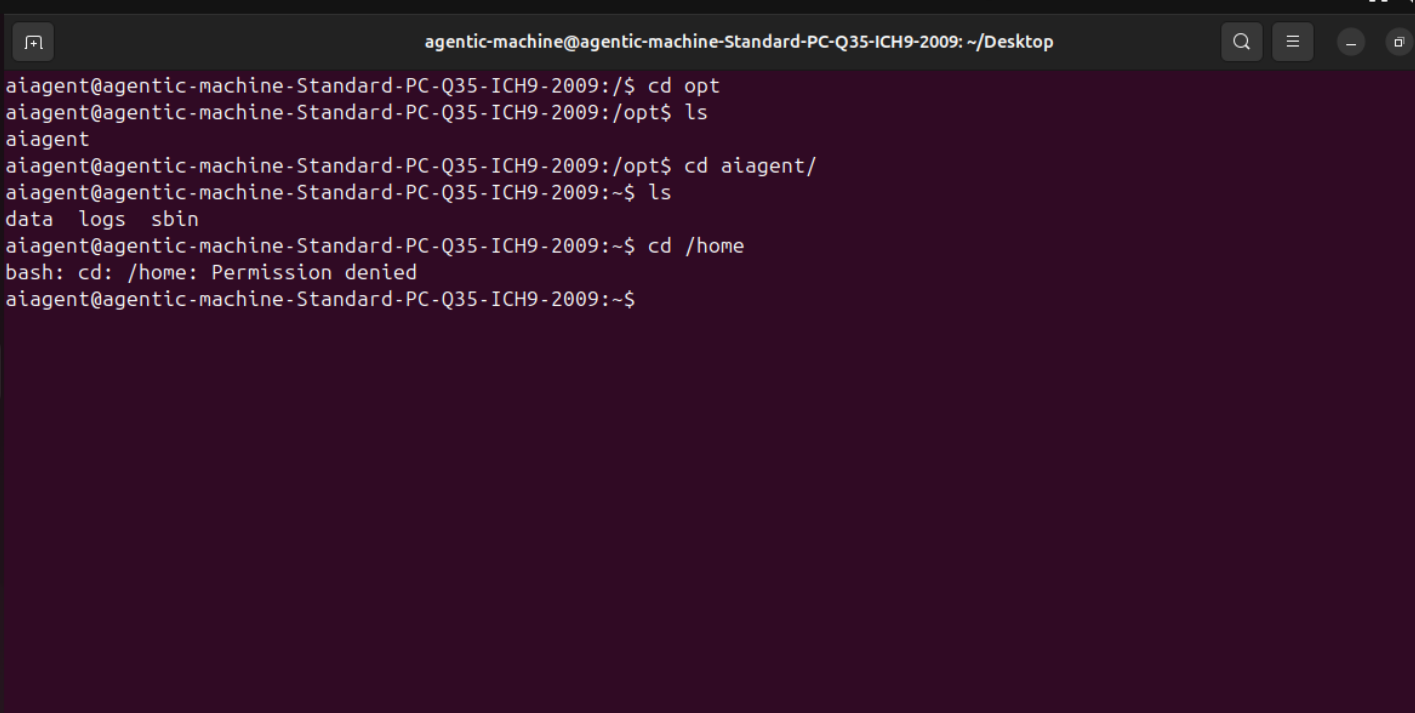
Because many agentic solutions are built with Rust or Node.js, you can deploy them in a dedicated directory and run them under a restricted account. By applying the previously mentioned access controls and permissions, the agent can operate within a confined environment, reducing the risk of accessing or modifying files outside its intended scope.
Example:
In this example an agent is running in it separate environment with it resource and isolated process
Conclusion: In the era of agentic AI, it is important to recognize that AI agents effectively operate as independent accounts within an ecosystem. As a result, they should be managed and secured in the same way as human or service accounts.